Start with the plan view
The outline is the board seen from above, and it is the first decision a shaper makes. Where the widest point sits matters as much as how wide it is. Push it forward and the board paddles easily and stays calm under your chest, but it resists tight turns from the tail. Pull it back and the board pivots readily off the back foot, asking for more precise weight placement during takeoff.
Much of what gets marketed as new is a revival. The twin-keel fish that Steve Lis developed in San Diego in the late 1960s returned to popularity in the 2000s because riders wanted something that worked in average, everyday waves. Mid-lengths between roughly seven and eight feet followed for the same reason. The shapes were not new; the demand for fun in small surf was.
Rocker: the curve you only see from the side
Rocker is the bottom curve from nose to tail. More rocker fits a board into steep, curving faces and stops the nose from catching, but it pushes water and slows paddling. Flatter rocker glides and accelerates, which is why small-wave boards look almost straight. The trade is simple and unforgiving: a flat board that feels fast on a knee-high day can feel stiff and catchy when the swell builds.
Rails: where water decides to let go
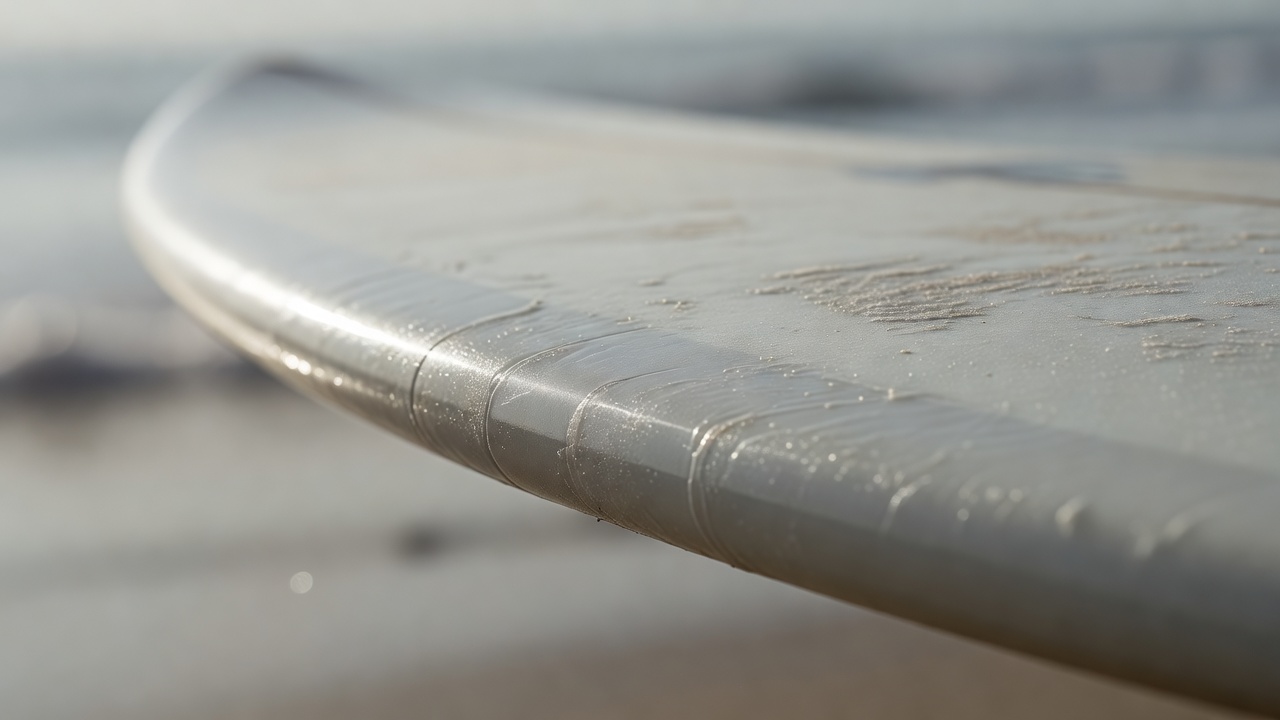
Rails are the edges, and they control how water wraps around the board. A hard, low rail releases water cleanly for speed and sharp direction changes. A soft, rounded rail lets water hug the board, which feels smoother and more forgiving but holds less in a fast turn. Many modern boards blend both: soft and full near the nose, hard and thin near the tail.
Bottom contours and fins
Concaves, channels and the bonzer design introduced by Malcolm and Duncan Campbell in the early 1970s all aim to manage water flow under the board. They can add drive and lift, but they also make the board harder to repair and harder to judge second-hand. Fins carry their own history: Tom Blake fitted a fixed keel to a board in the 1930s, George Greenough's flexible fins inspired a generation of designs, and Simon Anderson's three-fin thruster of 1981 became the default setup it still is today.
Established ideas and genuine experiments
Shapes with decades of riding behind them, such as fish, mid-lengths, thrusters and twin fins, are established. You will find them at most board shops and in rental fleets. Asymmetric boards, which use different rail lines for heelside and toeside turns, go back to Carl Ekstrom's work in the 1960s and have been explored more recently by shapers such as Ryan Burch. They remain a niche, rewarding but hard to find to rent. The finless wooden alaia, revived by Tom Wegener in Australia during the 2000s, is the most humbling experiment of all: fast, loose and very difficult for beginners.
| If you change | You usually gain | You usually give up |
|---|---|---|
| Wider nose, forward widest point | Easier paddling and stable takeoffs | Snappy tail turns |
| Flatter rocker | Speed and glide in small waves | Control in steep surf |
| Harder rails | Release, speed and precision | Forgiveness for late weight shifts |
| Deep channels or concaves | Drive and lift | Simple repairs, clear resale value |
| Shorter overall length | Portability and manoeuvrability | Wave count and paddle speed |
How to test a shape before you buy
Rent or borrow before committing. Demo days, surf schools and board libraries let you ride the same shape in several conditions. Ride it on an ordinary day, not the best one, because that is when you will use it most. Note how it paddles, how early it catches waves and whether turns feel natural or forced. If a shape only works when everything is perfect, it is a specialist tool. That can be wonderful, provided you choose it knowing what it gives up.